
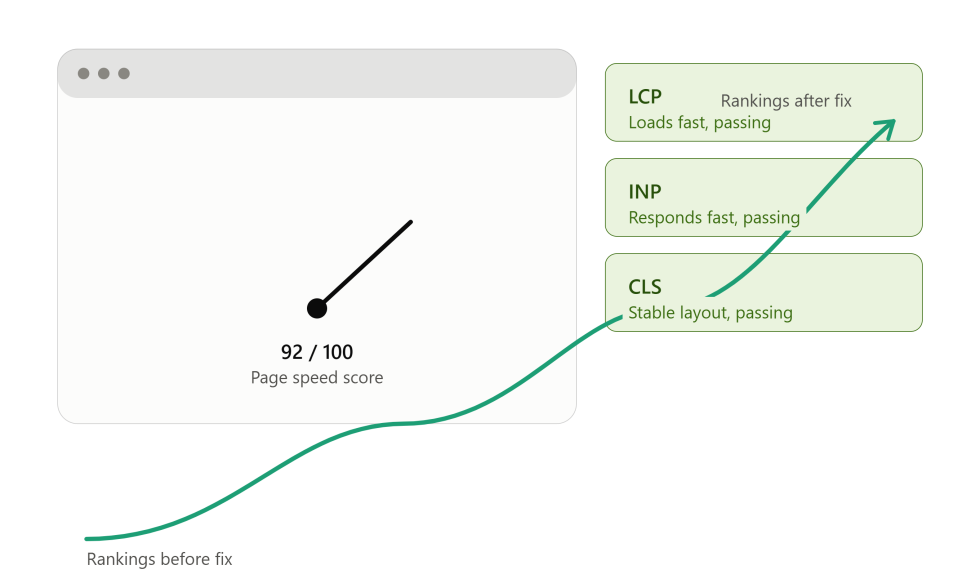
Google Core Web Vitals Fix Services: Boost Speed, SEO Rankings & Conversions
If your website is slow to load, sluggish to respond, or its content jumps around as it loads, Google notices — and so do your visitors. Core Web Vitals are no longer a “nice to have” metric buried in a developer dashboard. They are a confirmed Google ranking signal and a direct driver of bounce rate, user trust, and lead conversion.
At Softsys Corporation, a technology solutions provider headquartered in Pune, India, since 2014, we offer dedicated Google Core Web Vitals fix services that diagnose the exact technical bottlenecks slowing your site down — and fix them, so your pages rank higher, load faster, and convert more visitors into customers.
What Are Google Core Web Vitals?
Core Web Vitals are a set of measurable signals Google uses to evaluate real-world user experience on a webpage. The three core metrics are:
- LCP (Largest Contentful Paint) — how quickly the main content of a page becomes visible. Google recommends LCP under 2.5 seconds.
- INP (Interaction to Next Paint) — how responsive a page feels when a user clicks, taps, or types. Google recommends INP under 200 milliseconds. INP replaced First Input Delay (FID) as the official responsiveness metric.
- CLS (Cumulative Layout Shift) — how visually stable a page is while loading. Google recommends a CLS score under 0.1, meaning buttons, images, and text shouldn’t jump around as the page renders.
These metrics feed directly into Google’s Page Experience signals, which influence both organic search rankings and Google Ads Quality Score.
Why Poor Core Web Vitals Are Costing You Leads
A technically “live” website isn’t the same as a website that performs. Common symptoms we see across client audits include:
- Visitors bouncing before the hero section even finishes loading
- Contact forms that feel laggy or unresponsive on mobile
- Buttons or images that shift position mid-scroll, causing accidental clicks
- Search rankings that plateau despite strong content and backlinks
- Higher-than-expected cost-per-click on Google Ads due to a low Quality Score
Every one of these issues traces back to LCP, INP, or CLS problems — and every one of them is fixable with the right technical approach.
Common Root Causes We Diagnose
Through hands-on audits across WordPress, custom PHP, React, Angular, and Node.js stacks, our engineering team typically finds one or more of the following:
- Unoptimized images — oversized files, missing lazy-loading, no modern formats like WebP/AVIF
- Render-blocking JavaScript and CSS — scripts and stylesheets that delay first paint
- Bloated third-party scripts — chat widgets, ad tags, and analytics tools loading synchronously
- Poor server response times (TTFB) — weak hosting, no caching layer, unoptimized database queries
- Missing dimensions on images and embeds — the leading cause of layout shift
- Web fonts causing flash of invisible/unstyled text (FOIT/FOUT)
- Heavy, unminified code bundles with no code-splitting
How Softsys Corporation’s Core Web Vitals Fix Service Works
We don’t hand you a generic PageSpeed Insights printout and call it a day. Our process is built around measurable, before-and-after results.
1. Full Technical Audit
We run field data (CrUX report) and lab data (Lighthouse, PageSpeed Insights, WebPageTest) side by side to separate real user experience from synthetic test noise, across desktop and mobile.
2. Root-Cause Diagnosis
Every flagged issue is traced back to its actual source in your codebase, CMS configuration, or hosting environment — not just the surface-level warning.
3. Performance Engineering
Depending on your stack, this includes:
- Image compression, responsive sizing, and lazy-loading
- Critical CSS extraction and deferred/async JavaScript loading
- Code-splitting and removing unused JavaScript
- Server-side caching, CDN configuration, and database query optimization
- Font-loading strategy fixes and explicit width/height attributes to eliminate layout shift
- Third-party script audits and consolidation
4. Validation & Monitoring
We re-test against Google’s official thresholds and set up ongoing monitoring so performance gains don’t quietly regress after your next content update or plugin install.
5. SEO Alignment
Because Core Web Vitals sit inside Google’s broader Page Experience signals, our fixes are coordinated with on-page SEO best practices — clean semantic markup, mobile usability, and Core Web Vitals-friendly theme/plugin choices — so speed gains translate into actual ranking movement, not just a better lab score.
The Business Impact of Fixing Core Web Vitals
- Higher organic rankings — page experience is a confirmed Google ranking factor, especially in competitive SERPs where content quality is comparable
- Lower bounce rate — every additional second of load time increases the likelihood a visitor leaves before converting
- Better conversion rates — a responsive, stable page reduces mis-clicks and builds trust at the moment a visitor considers filling out a form or making a purchase
- Stronger paid ad performance — Google Ads Quality Score factors in landing page experience, directly affecting your cost-per-click
- Improved mobile experience — where Core Web Vitals issues are typically most severe and most visible to your audience
Why Choose Softsys Corporation
Softsys Corporation has been delivering cost-effective, result-oriented IT and digital engineering solutions to global businesses since 2014. Our Core Web Vitals fix services are backed by:
- Hands-on experience across PHP, Java, React, Angular, Python, and Node.js environments
- A combined approach spanning application development, cloud infrastructure, and digital strategy — so performance fixes are engineered correctly at the code and server level, not patched with plugins alone
- Transparent, before-and-after performance reporting for every engagement
- A track record with 500+ companies across banking, healthcare, insurance, life sciences, and software industries
We treat every Core Web Vitals engagement as both a technical fix and a growth investment — the same page that ranks better is the page that converts better.
Frequently Asked Questions
How long does it take to fix Core Web Vitals issues? Most websites see measurable LCP, INP, and CLS improvements within 2–4 weeks, depending on site complexity, current hosting, and how much custom code versus off-the-shelf theme/plugin code is involved.
Will fixing Core Web Vitals guarantee a #1 Google ranking? No single factor guarantees rankings. Core Web Vitals are one confirmed ranking signal among many (content relevance, backlinks, E-E-A-T). What we guarantee is a measurably faster, more stable, more responsive site — which removes a real barrier to ranking and directly improves user experience and conversions.
Do you fix Core Web Vitals for WordPress sites specifically? Yes. WordPress is one of our most common environments, and we routinely resolve Core Web Vitals issues caused by themes, page builders, and plugin bloat without a full rebuild.
Can you fix Core Web Vitals without redesigning my website? In most cases, yes. Core Web Vitals issues are usually technical and code-level rather than visual, so we can typically resolve them without changing your site’s design or user experience.
Get Your Free Core Web Vitals Audit
If your Google Search Console is flagging “poor” or “needs improvement” for LCP, INP, or CLS, don’t wait for it to quietly erode your rankings and lead flow. Google Core Web Vitals Fix Services.
Talk to Softsys Corporation today:
- Phone: +91 9503740552
- Email: hello@softsyscorporation.com
- WhatsApp: Chat with us
- Explore our related services: Digital Strategy and Design | Application Development and Management | Cloud and Infrastructure
Softsys Corporation — Digital Engineering. Applying Developmental. Pune, Maharashtra, India.


