Pharma Manufacturing Software India: The Complete Buyer’s Guide for GMP-Compliant Plants
India makes roughly one in five generic tablets and capsules consumed worldwide, and its pharmaceutical exports keep climbing every year. That scale is exactly why pharma manufacturing software in India has moved from a “nice to have” IT project to a board-level priority. Regulators want digital batch records instead of paper logbooks. Global buyers audit Indian plants against US FDA and EU GMP expectations, not just Indian Schedule M. And plant heads are under pressure to cut batch release time from days to hours.
This guide walks through what pharma manufacturing software actually does, the modules an Indian plant needs, the compliance rules driving adoption, how to pick a vendor, and what implementation really costs — so you can make a confident, informed decision instead of buying on a sales pitch.
What Is Pharma Manufacturing Software?
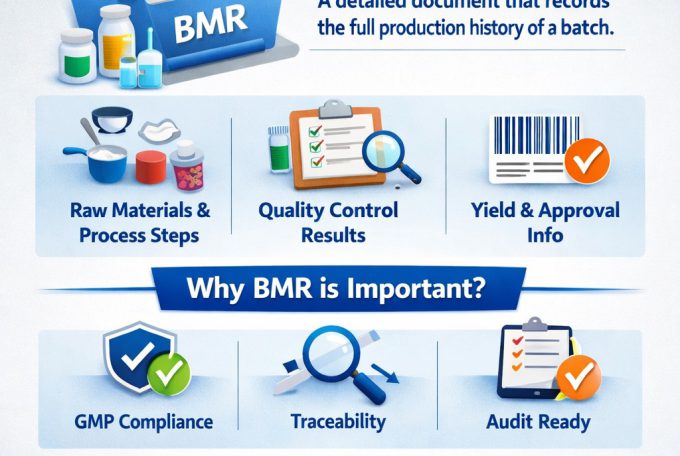
Pharma manufacturing software is a connected set of digital systems that plan, execute, record, and release every step of drug production — from raw material receipt to finished-goods dispatch — while automatically enforcing Good Manufacturing Practice (GMP) rules. Instead of operators filling paper batch manufacturing records (BMRs) and quality teams manually cross-checking them days later, the software captures data at the point of activity, flags deviations in real time, and builds an audit-ready electronic record automatically.
At a minimum, the software needs to answer four questions instantly, at any time, for any batch:
- What happened, in what order, and who did it?
- Did every step stay inside its approved specification?
- Is the batch ready to release, and what open items are blocking it?
- Can we prove all of this to a regulator without digging through files?
Why Indian Pharma Manufacturers Are Digitizing Now
A few forces are converging at once, and they explain why this has become an urgent buying decision rather than a future roadmap item:
Revised Schedule M is now the baseline, not the ceiling. India’s updated Schedule M rules bring domestic GMP requirements closer to WHO and international standards, with explicit expectations around quality risk management, computerized systems, and data integrity — areas paper systems simply cannot satisfy consistently.
Export markets scrutinize data integrity first. US FDA 483 observations and EU GMP non-compliance reports for Indian sites disproportionately cite data integrity gaps — backdated entries, uncontrolled spreadsheets, and audit trails that don’t exist. Software with ALCOA+ principles (Attributable, Legible, Contemporaneous, Original, Accurate) built in removes the single biggest audit risk.
Batch release is a working-capital problem, not just a compliance one. Every day a batch sits in quality review before release is a day of inventory sitting on the balance sheet. Digitized batch records and exception-based review routinely cut release cycles from 5–7 days to under 24 hours.
Talent and shift handovers create knowledge gaps. Paper SOPs and tribal knowledge don’t survive attrition. A system that enforces the correct sequence of steps protects the plant from operator-dependent variation.
Core Modules Every Pharma Manufacturing Software Should Include
Not every plant needs every module on day one, but a system worth buying should be built to grow into all of these:
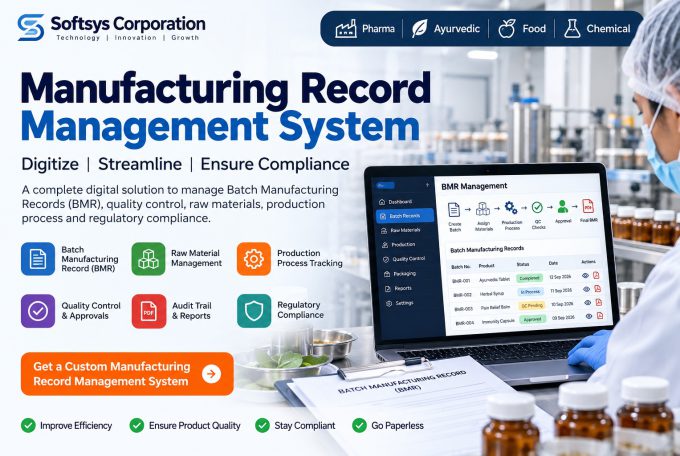
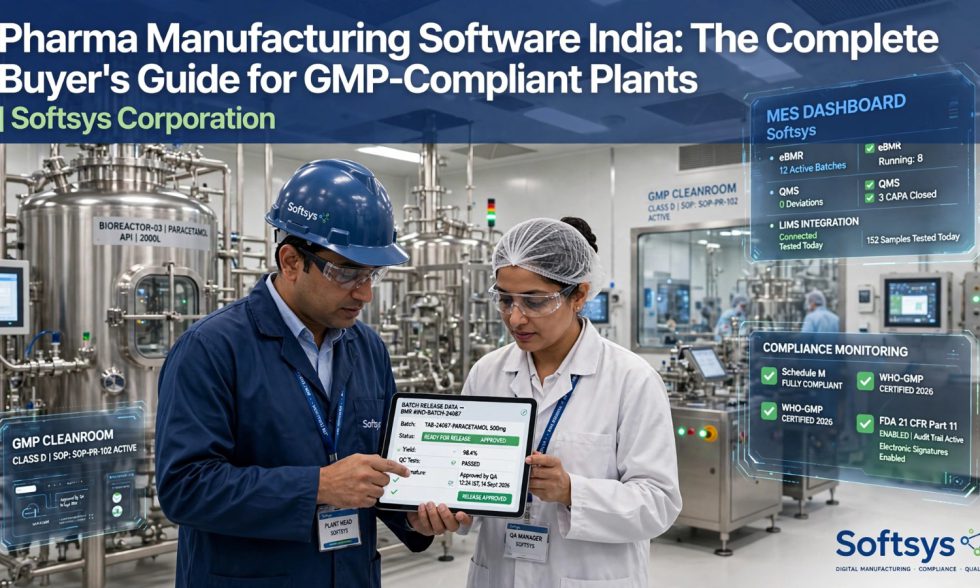
1. Manufacturing Execution System (MES) / Electronic Batch Manufacturing Records (eBMR) Digitizes the master formula and batch record, guides operators step by step, enforces in-process checks, and time-stamps every entry. This is usually the highest-ROI module because it directly replaces the most error-prone paper process on the floor.
2. Quality Management System (QMS) Manages deviations, CAPAs, change controls, OOS/OOT investigations, and SOP document control in one traceable workflow instead of scattered email threads and shared drives.
3. LIMS Integration Connects lab instruments and lab test results directly to the batch record, so quality release doesn’t wait on someone re-typing values from a lab notebook.
4. Track and Trace / Serialization Captures unique batch and unit-level identifiers to meet Indian DPCO and global anti-counterfeiting requirements like DSCSA and the EU Falsified Medicines Directive, especially critical for export-oriented plants.
5. Environmental Monitoring and Equipment Integration Pulls live data from HVAC, weighing systems, and PLCs on the shop floor so environmental excursions are caught immediately rather than discovered during a manual log review.
6. Analytics and Compliance Dashboards Gives plant heads and quality heads real-time visibility into batch status, right-first-time rate, deviation trends, and equipment OEE — the data regulators and management both want to see.
7. Audit Trail and Electronic Signatures Non-negotiable for 21 CFR Part 11 and Annex 11 alignment: every action is logged, timestamped, and attributable to a specific user with role-based access control.
Buying Considerations Specific to India
International MES/QMS platforms are powerful but often expensive to license and slow to customize for an Indian plant’s realities — multiple product lines on shared lines, frequent SKU changeovers, and Schedule M documentation formats that differ from FDA-style templates. A few things worth weighing before you sign:
- Configurability over rigid out-of-box workflows. Your batch record formats, approval hierarchies, and SOP structures are specific to your site; the software should adapt to them, not force a rebuild of your quality system.
- On-premise, cloud, or hybrid deployment. Data residency, plant network reliability, and IT infrastructure maturity vary widely across Indian manufacturing hubs, so the deployment model matters as much as the feature list.
- Integration with existing ERP. Most Indian pharma companies already run an ERP for procurement and finance; manufacturing software that doesn’t talk to it cleanly just creates a second source of truth.
- Local implementation and support. GMP software lives or dies on how quickly issues get resolved during a live production shift — a vendor with engineers in the same time zone (and ideally the same city) matters more than it sounds.
- Total cost over 3–5 years, not just license cost. Factor in validation effort (IQ/OQ/PQ), training, and the cost of future module additions, not just the initial quote.
How Softsys Corporation Approaches Pharma Manufacturing Software
Softsys Corporation is a Pune-based digital engineering company that has worked across life sciences and industrial clients since 2014, building custom software product engineering, enterprise integration, and data and analytics solutions rather than reselling a rigid off-the-shelf license.
For pharma manufacturers, that translates into manufacturing software shaped around your actual batch records and SOPs instead of the other way around — eBMR and MES workflows configured to your product lines, QMS modules that mirror how your deviations and CAPAs are already structured, and integration layers that connect the shop floor, your lab, and your existing ERP into one audit-ready system. Because the engineering team sits in India, validation documentation, on-site UAT, and go-live support happen on your plant’s schedule, not a vendor’s ticket queue in a different time zone.
Frequently Asked Questions
Is pharma manufacturing software mandatory under the new Schedule M rules? Schedule M doesn’t name specific software, but its requirements around computerized systems, data integrity, and quality risk management are very difficult to satisfy consistently with paper-based records alone, which is why digitization has become the practical path to compliance.
How long does implementation typically take? A single-line eBMR/MES rollout can go live in 8–12 weeks; a full MES + QMS + LIMS integration across a multi-product facility usually runs 4–9 months depending on validation scope.
Can this integrate with the ERP we already use? Yes — a well-built manufacturing software layer should integrate with common ERPs (SAP, Oracle, or India-specific platforms) via API rather than requiring you to replace existing finance and procurement systems.
Do we need to be cloud-based, or can this run on-premise? Both are viable. Many Indian plants start with an on-premise or hybrid deployment for network reliability and data residency reasons, then move workloads to the cloud as infrastructure matures.
Ready to Digitize Your Plant?
If paper batch records, manual deviation tracking, or slow batch release are costing you time and audit risk, it’s worth a focused conversation rather than a generic demo. Talk to Softsys Corporation about a pharma manufacturing software approach built around your existing SOPs, product lines, and compliance requirements — call +91 9503740552, email hello@softsyscorporation.com, or get in touch here to schedule a walkthrough.