CRM for Lead Management Automation Solution
Understanding CRM and Lead Management
What is CRM?
A Customer Relationship Management (CRM) system is a software platform designed to help businesses manage interactions with current and potential customers. Instead of juggling spreadsheets, emails, and sticky notes, a CRM organizes all customer data into one centralized system. This allows sales teams, marketing teams, and support departments to collaborate more effectively and deliver better customer experiences. According to industry insights, modern CRM platforms integrate tools for contact management, sales pipeline tracking, reporting, marketing automation, and analytics, giving businesses a complete overview of customer relationships.
Think of CRM as the central nervous system of a business’s sales and customer operations. Every lead, conversation, meeting, and follow-up is recorded and tracked. This helps companies build long-term relationships rather than just completing one-time transactions. Businesses today operate in highly competitive environments where customer expectations are constantly evolving. A CRM system ensures that no interaction goes unnoticed and no opportunity slips through the cracks.
Another major advantage of CRM is its ability to automate repetitive processes. Instead of manually assigning tasks, sending follow-ups, or updating spreadsheets, the CRM system handles these actions automatically. Sales teams can then focus on building relationships and closing deals rather than administrative tasks. As businesses grow, managing hundreds or even thousands of leads becomes increasingly complex, making CRM systems essential for maintaining efficiency and scalability.
What is Lead Management in Business?
Lead management refers to the process of capturing, tracking, nurturing, and converting potential customers—known as leads—into paying customers. It begins the moment someone shows interest in a company’s product or service, whether by filling out a website form, clicking on an advertisement, or contacting the sales team. From that point forward, businesses must carefully manage the relationship until the prospect is ready to make a purchase.
The goal of lead management is simple: turn interest into revenue. However, the journey from lead to customer is rarely straightforward. Prospects may need multiple interactions, personalized communication, and timely follow-ups before making a decision. Without a structured lead management system, businesses risk losing potential customers due to delayed responses or poor organization.

A well-implemented CRM lead management system ensures that every lead is captured and tracked from the first interaction to the final sale. It organizes lead data, monitors communication history, and assigns tasks to the appropriate sales representatives. According to research, businesses using CRM systems report an average 29% increase in sales revenue, while lead conversion rates can improve dramatically when lead management is properly implemented.
Ultimately, effective lead management ensures that sales teams always know who to contact, when to follow up, and how to close deals efficiently.
Why Businesses Need CRM for Lead Management
Challenges of Manual Lead Management
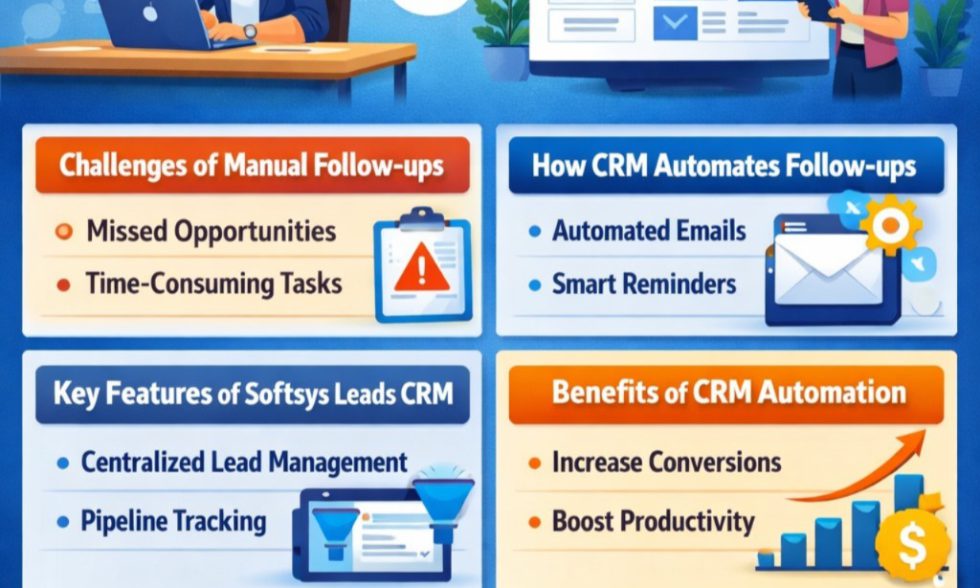
Many businesses still rely on manual methods such as spreadsheets, emails, or notebooks to manage their leads. While this approach may work for a small number of prospects, it quickly becomes overwhelming as the business grows. Imagine trying to track hundreds of customer interactions without a structured system. Leads get lost, follow-ups are forgotten, and valuable opportunities slip away.
Manual lead management often creates confusion among sales teams. Multiple team members might contact the same lead, while others receive no follow-up at all. Data becomes scattered across different platforms, making it difficult to understand the full customer journey. This lack of organization leads to missed opportunities and inconsistent communication with prospects.
Another challenge is delayed response time. Studies show that responding quickly to leads dramatically increases the chances of conversion. However, when leads are managed manually, sales representatives might not notice new inquiries immediately. By the time they respond, the prospect may have already chosen a competitor.
Additionally, manual processes make it difficult to analyze performance. Businesses cannot easily track which marketing campaigns generate the most leads or which sales strategies produce the best results. Without these insights, companies struggle to optimize their sales processes and maximize revenue.
Benefits of Automating Lead Management
Automation completely transforms how businesses handle their leads. With a CRM lead management automation system, tasks that once required hours of manual effort are completed instantly. Leads are automatically captured from websites, social media, and marketing campaigns and stored in a centralized database.
Automation also ensures that leads are assigned to the right sales representatives immediately. For example, a CRM can route leads based on location, product interest, or industry. This process, known as real-time lead routing, ensures faster response times and better customer experiences.
Another powerful advantage is automated follow-ups. CRM systems can send emails, reminders, or notifications to ensure that every lead receives consistent communication. Instead of relying on memory or manual reminders, the system ensures that no lead is neglected.
Automation also improves productivity by eliminating repetitive tasks such as data entry and reporting. Sales teams can spend more time engaging with prospects and less time managing spreadsheets. Over time, this leads to higher conversion rates, increased revenue, and stronger customer relationships.
Key Features of a CRM Lead Management System
Lead Capture and Centralized Data
One of the most critical features of a CRM lead management system is lead capture. Businesses generate leads from various sources, including websites, social media platforms, online advertisements, email campaigns, and offline events. A CRM automatically collects and stores these leads in one centralized location.
Centralizing data ensures that sales teams have access to complete customer profiles, including contact details, communication history, and engagement activities. This eliminates confusion and ensures that everyone in the organization works with the same information.
A centralized database also makes it easier to analyze lead sources. Businesses can identify which marketing channels generate the most valuable prospects and allocate resources accordingly. Over time, this insight allows companies to optimize their marketing strategies and increase return on investment.
Lead Tracking and Pipeline Management
Lead tracking is another essential feature of CRM systems. It allows businesses to monitor the progress of each lead as it moves through the sales pipeline. The pipeline typically includes stages such as lead capture, qualification, proposal, negotiation, and closing.
By visualizing the pipeline, sales teams can quickly identify opportunities that require attention. For example, if a lead has remained in the proposal stage for too long, the CRM system may trigger a reminder to follow up.
Pipeline management also helps managers evaluate the performance of their sales teams. They can see how many leads are being processed, how quickly deals are progressing, and where bottlenecks occur. This transparency allows managers to make data-driven decisions and improve overall sales performance.
Lead Scoring and Prioritization
Not all leads are equally valuable. Some prospects are ready to purchase immediately, while others require further nurturing. CRM systems address this challenge through lead scoring, a process that assigns a value to each lead based on factors such as engagement level, demographics, and behavior. CRM for Lead Management Automation Solution
For example, a lead who frequently visits the website, downloads resources, and opens emails may receive a higher score than someone who only signed up once. By prioritizing high-quality leads, sales teams can focus their efforts where they matter most.
This approach significantly improves efficiency and increases the likelihood of successful conversions. Instead of wasting time on low-quality leads, sales representatives can concentrate on prospects with the highest potential.
Workflow Automation and Task Management
Workflow automation is the backbone of modern CRM systems. It allows businesses to create automated processes that streamline daily operations. For example, when a new lead enters the system, the CRM can automatically assign it to a sales representative, schedule a follow-up task, and send a welcome email.
Task management features ensure that sales teams stay organized and productive. Representatives receive reminders for calls, meetings, and follow-ups, preventing important opportunities from being overlooked.
Automation also reduces human error. Since tasks are executed according to predefined rules, the system ensures consistency and accuracy across all processes.
How CRM Automation Improves Sales Performance
Faster Lead Response
Speed is one of the most critical factors in lead conversion. When a potential customer reaches out, they expect a prompt response. A delay of even a few hours can significantly reduce the chances of closing the deal.
CRM automation ensures that leads are instantly captured and assigned to the appropriate sales representative. Automated notifications alert the team about new inquiries, enabling immediate engagement with prospects. CRM for Lead Management Automation Solution
Quick responses create positive first impressions and demonstrate professionalism. Prospects are more likely to trust businesses that respond promptly and provide relevant information.
Better Customer Insights
CRM systems collect valuable data about customer behavior, preferences, and interactions. This information provides powerful insights that help businesses understand their audience better.
By analyzing this data, companies can identify patterns and trends that influence purchasing decisions. For example, they might discover that certain marketing campaigns generate higher conversion rates or that specific customer segments respond better to personalized communication.
These insights allow businesses to refine their sales strategies and deliver more targeted marketing campaigns. As a result, customer relationships become stronger and sales performance improves.
Introducing Softsys Leads CRM
Overview of Softsys Leads CRM Solution
The Softsys Leads CRM is a powerful lead management automation solution designed to help businesses capture, manage, and convert leads more efficiently. It provides a centralized platform where companies can track every interaction with potential customers and streamline their sales processes.
You can explore the CRM features here:
https://www.softsyscorporation.com/our-products/leads-crm/
Softsys Leads CRM is built with simplicity and scalability in mind. Whether you are a startup managing a handful of leads or an enterprise handling thousands of prospects, the system adapts to your needs. It eliminates manual processes and replaces them with intelligent automation that improves productivity and accuracy.
Key Features of Softsys Leads CRM
Softsys Leads CRM offers a range of features designed to enhance lead management and sales performance:
| Feature | Description |
|---|---|
| Lead Capture | Automatically collects leads from multiple channels |
| Lead Tracking | Monitors lead progress across the sales pipeline |
| Automated Follow-Ups | Sends reminders and notifications for timely communication |
| Task Management | Assigns tasks and schedules activities for sales teams |
| Reporting & Analytics | Provides insights into sales performance and lead sources |
These features work together to create a seamless workflow that improves efficiency and boosts sales conversions. CRM for Lead Management Automation Solution
Industries That Benefit from CRM Lead Automation
Small Businesses and Startups
Small businesses often operate with limited resources, making efficiency crucial for success. CRM automation allows startups to manage leads effectively without hiring large sales teams.
By automating tasks such as follow-ups, data entry, and reporting, small businesses can focus on building relationships with customers and growing their brand.
Enterprises and Growing Companies
Large organizations handle massive volumes of leads from multiple channels. Without a robust CRM system, managing these leads becomes nearly impossible.
CRM automation ensures that every lead is tracked, analyzed, and nurtured effectively. This enables enterprises to maintain consistent communication with customers and achieve sustainable growth.
How to Choose the Right CRM for Lead Management
Essential Factors to Consider
When selecting a CRM system for lead management, businesses should consider several key factors:
Ease of use and user-friendly interface
Automation capabilities
Integration with marketing tools and other software
Customization options
Reporting and analytics features
Choosing the right CRM ensures that the system aligns with business goals and supports long-term growth.
The Future of CRM and Lead Automation
CRM technology continues to evolve rapidly. Artificial intelligence, predictive analytics, and automation are transforming how businesses interact with customers. Research indicates that AI adoption in CRM is expected to increase dramatically between 2025 and 2030, enabling smarter insights and automated decision-making.
As technology advances, CRM systems will become even more intelligent and proactive. Instead of simply tracking data, they will predict customer behavior and recommend the best actions for sales teams.
Conclusion
CRM lead management automation has become an essential tool for modern businesses. It streamlines the process of capturing, tracking, and converting leads while eliminating manual inefficiencies. By centralizing data, automating workflows, and providing valuable insights, CRM systems empower sales teams to work smarter and achieve better results.
Solutions like Softsys Leads CRM demonstrate how technology can transform sales operations and improve customer relationships. Businesses that adopt CRM automation gain a significant competitive advantage in today’s fast-paced digital marketplace. CRM for Lead Management Automation Solution